
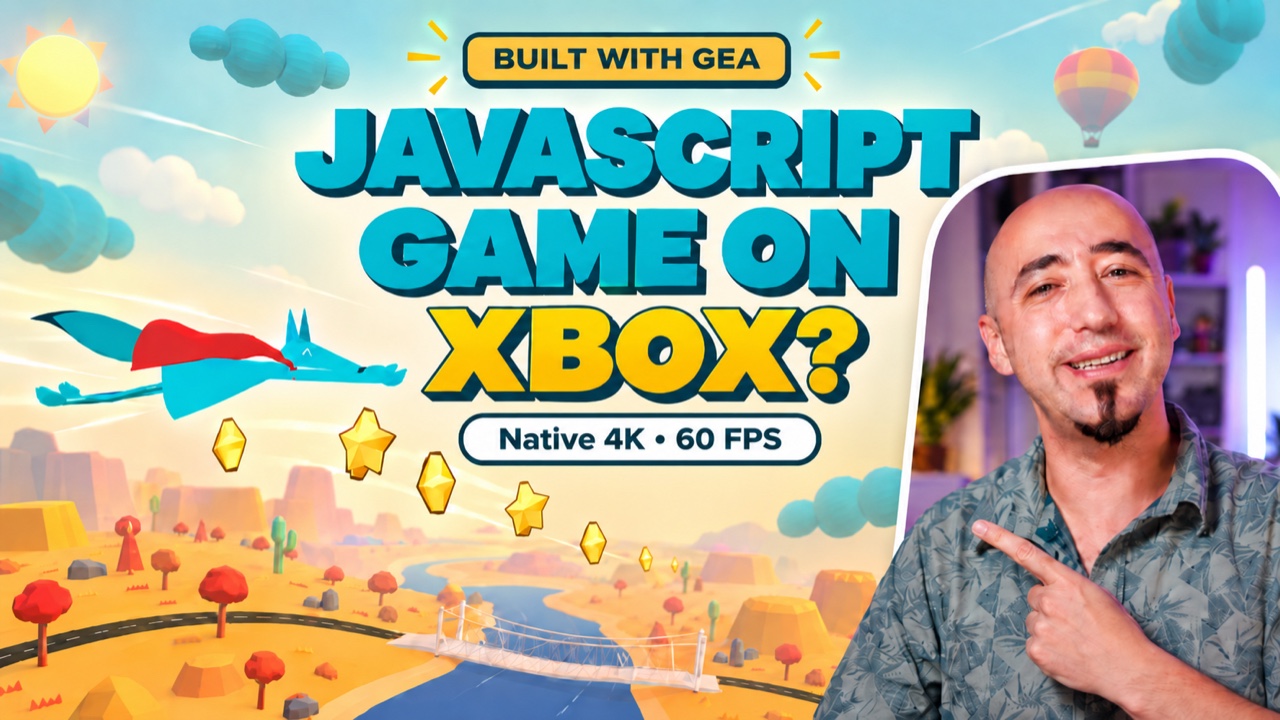
For years, the software engineering world has operated with strict boundaries between web development, mobile apps, and native hardware programming. Building a high-performance console game typically required specialized game engines, dedicated rendering pipelines, and C++ proficiency.
Meanwhile, web engineers looking to build interactive 3D experiences utilized JavaScript, WebGL, and libraries like Three.js, but these projects were often confined to the browser. This technological divide meant that games have historically been extremely difficult to produce for cross-platform releases.
GEA: GEA Stack emerges as a groundbreaking technology that is reshaping the landscape of application and game development. Originally designed to bring modern web development paradigms to embedded devices and microcontrollers, GEA Stack is now proving to be a functional tool for game developers.
The platform allows development teams to build high quality games natively in JavaScript and deploy them seamlessly across heavy-duty consoles like the Xbox Series X.
During a recent YouTube livestream, Coyotiv CEO Armağan Amcalar highlighted the magnitude of this shift:
"We are on the brink of this revolution. The most well-known language on the planet for humans and AI, which is JavaScript, can run code safely without crashing, without weird bugs on any target platforms that you can think of." — Armağan Amcalar
The secret of performance: ahead-of-time compilation
The secret behind running a JavaScript-based game with console-level performance lies in GEA Stack's unique compiler architecture. Unlike tools that run a heavy JavaScript virtual machine (VM) on the target device, or interpreters that parse code at runtime, GEA uses its "geatsc" compiler to transform TypeScript, JSX, and standard CSS directly into native C++ ahead of time and produces native code for the target platform.
Because there is no VM and no runtime interpreter shipped to the console, the resulting native binaries bypass the heavy initialization costs associated with traditional JavaScript engines. In computationally demanding scenarios, the GEA-compiled native code runs significantly faster than standard Node.js, allowing complex 3D computations, matrix operations, and particle effects to execute with high efficiency.
As an ahead-of-time (AOT) compiler, GEA takes advantage of native hardware instructions, resulting in an experience that rivals hand-written, optimized C++ code.
In practice, Amcalar described the workflow simply: build the game in Three.js, configure the intended target, and compile it. During the stream, the same game was demonstrated as a native application on both macOS and Xbox Series X.
Unified codebase for multi-platform deployment: One of the greatest logistical challenges in game development is porting. Releasing a game on PC, macOS, mobile, and consoles traditionally requires massive code rewrites and separate toolchains.
However, GEA Stack collapses this toolchain entirely. A game written in Three.js using GEA Stack can be deployed to a browser, Windows, macOS, Linux, iOS, Android, and Xbox using a single codebase. The developer initiates a standard command line instruction, and the compiler handles the platform-specific generation, yielding a fully native application for the chosen target.
Emphasizing the flexibility of this unified approach, Amcalar noted:
"Gone are the days of lock-in to one platform, one screen, one shape. The same code can be run anywhere." — Armağan Amcalar
On the other hand: Performance is mostly one of the first questions that comes up when JavaScript and games appear in the same sentence. GEA's answer is compilation.
The stack does not simply place an interpreted JavaScript application inside another environment. The TypeScript source is compiled to C++, which is then compiled into machine code. This also gives the compiler room to optimize the generated output for the target platform.
What GEA aims to remove is a different layer of overhead: the need to interpret the application at runtime simply because the game was originally written with web technologies.
Revolutionizing game UI and audio
Building user interfaces (UI) for games — such as menus, heads-up displays, and inventory screens — can also be a tedious process. GEA Stack brings the declarative power of the web to game UI design. Engineering teams can style game interfaces using real CSS, including Flexbox and animations, and render them natively at 60 frames per second (FPS).
Furthermore: GEA includes native support for the Web Audio API, enabling complex audio effects and soundscapes using familiar web standards that compile directly into native code for the target device.
Empowering AI-assisted game development
The rise of large language models (LLMs) and AI coding agents has transformed software engineering. However, AI agents are significantly more proficient at generating web code than writing complex C++ for game consoles. By making JavaScript the native language of hardware, GEA Stack aligns perfectly with the AI revolution, allowing studios to leverage AI agents to generate game logic, 3D scenes, or UI components effortlessly, knowing GEA will compile it safely and performantly.
However: GEA does not make the difficult parts of building a game disappear. Developers still have to design the experience, create or source assets, manage scenes, write game logic and optimize performance. But the proposition for game developers is becoming clearer: the skills and code used to build interactive experiences for the web may no longer have to stop at the browser.
To demonstrate the capabilities of GEA Stack, the Coyotiv team developed and released Skytail, an inaugural game built entirely on this new architecture. Skytail is a fast-paced, Three.js-based flight game featuring the Coyotiv mascot. The gameplay involves flying through a beautifully rendered 3D world, navigating day and night cycles, and transitioning through dynamic environmental seasons ranging from spring to winter.
More importantly for GEA, Skytail is less a showcase of game design than a demonstration of the development pipeline behind it. The same Three.js project can move beyond its original web context and run as a native game on another target.
Originally a web application codebase, Skytail was compiled directly to run natively at 60 FPS on the Xbox Series X, macOS, and mobile devices without altering the core logic.
The game is available to experience firsthand here.